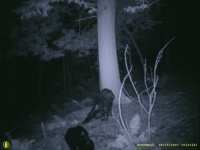
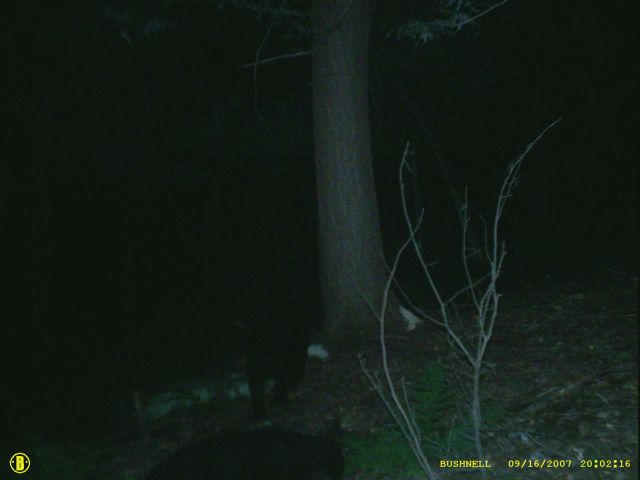
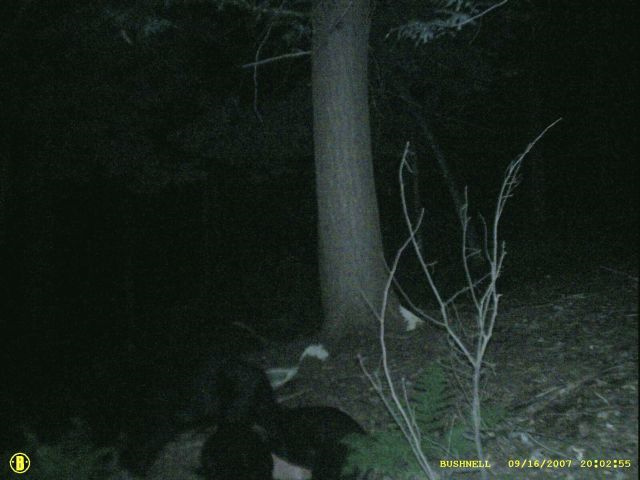
On September 16th, 2007 a Pennsylvania hunter shot some very odd photographs with a Bushnell trail camera. Did they show a mangy bear? Or something more mysterious...
By DoctorAtlantis (William Smith)
My first exposure to the creature that bigfoot aficionados refer to as "Jake" was in late October of 2007 when Fox News picked up the story from the AP wire service. Here's the short version: On September 16, 2007 Pennsylvania deer hunter Rick Jacobs had setup a Bushnell trail camera to try and find deer. He had put out a mineral-lick as bait, and setup the camera to automatically take photos of animals moving in front of the camera.
When Mr. Jacobs checked his photos, he had some strange results. Bears, an animal common to the region, were in some of the photos - but two of the photos showed an animal he did not recognize. What happened next is where the complications start.
According to the Bradford Era newspaper article from October 26, 2007:
"According to Paul Mateja, network administrator for the Buffalo, N.Y., Roman Catholic Diocese — and field researcher for the Bigfoot Research Organization — Jacobs’ daughter talked him into sending the pictures to their organization for an opinion."
That's the Bigfoot Field Research Organization the article is talking about. (www.bfro.net) This is an organization run by
Mr. Matt Moneymaker. According to the BFRO, they're a
field research organization. We'll check out some of their research shortly.
The photographs in their original un-edited form are available on the BFRO web site. Here are some links to those photographs and the BFRO's story about the photos:
Link to the main story on the BFRO page.
Photo of two cubs.
Photo of creature facing tree.
Photo of creature (orientation disputed).
color photo identified as two cubs (by BFRO).
color photo identified as mother and two cubs (by BFRO).
The Bradford Era ran a story about the photographs, and that's how the Pennsylvania Game Commission came to hear about the incident. Their public affairs officer, Jerry Feaser, saw the photographs and immediately recognized the animal as a bear with mange. That may not be obvious to most of us since for the majority of Americans our only exposure to bears it through seeing healthy bears on television and at zoos. But mange is a rough condition for bears (and other animals) and it makes their hair fall out and can lead to death if the bear has to winter with a limited coat and diminished body-fat. It also makes them look very strange.
Feaser contacted the Bradford Era and told them that the animal was a bear with mange, but the story went out onto the AP anyway. Fox News picked it up, and suddenly he was getting calls from all over the place with people wanting to know about this animal that the BFRO alleged to be a "juvenile bigfoot." Feaser even got a call from his own mother who heard the story down in Florida.
I contacted Jerry Feaser and asked him how he knew so certainly that the animal in the picture was a bear with mange. He had a ready reply. It turns out that there is a lot of mange going around in the bear population of Pennsylvania, and his bear biologist had just completed a story for the February edition of the PGC's magazine all about bears with mange. He had photos of bears with mange sitting on his desk. His biologist, Mark Ternent, agreed with that analysis. It was a bear.
It looked like a bear to me too, but I asked a few more experts.
First, I contacted Joe Clark with the USGS Southern Appalachian Field Laboratory. He said that "The bear hypothesis makes more sense and the proportions look pretty good to me."
South Carolina's Department of Natural Resources biologist Skip Still said, "I think it is a bear or a prank." He also helped me out with some more detailed research, which we'll get to in a moment.
The trouble with analyzing any photograph like this where there is a single fixed camera-position is that it is very difficult to determine the field depth. How far away are the objects being photographed? Without that kind of information one can't be certain of the size of anything in the photograph. Is that a spindly little pine in the background or a massive old-growth tree? In the photo below, you'll see a low-res animated gif image that demonstrates how I came to some of my conclusions. The only object that I can independently identify and measure is the salt-lick pan. In the photo it is flipped on its side, and one can clearly see (and measure) the width of a side. Those pans have 15" x 15" as their measurement on most catalogs, but I went out and bought one and measured it myself. The top pan width is in fact 15" - but the base, the part visible here - is actually 18" x 18". That information would still be of little use except that the BFRO published some daylight photos taken by researcher Paul Mateja. In Mateja's photo he's pasted a measuring rod on the tree as a reference. A little digging revealed that the increments represent 6" lengths. That still doesn't tell us how far the salt-lick pan is from the tree, but it gives us two planes of reference: Things roughly in line with the salt-lick's plane, and things roughly in line with the tree's plane.

As the animation shows, the photo Paul Matejo took did not exactly duplicate the angle of the original photos. The photos are taken on a hill, but I've tilted the angle so that I could use the guides in PhotoShop to help me line up the pictures better. The side of the trees, the root, and the circular lichen on the rock line up very closely. The branch in the foreground is a little off, but the biggest indicator is the amount of the tree behind the "big" tree in the background visible between Matejo's picture and the Jacobs photos. Still, since we're making relative measures within a plane, this will have to suffice until some intrepid investigators are able to duplicate the photos with a little more accuracy.
Speaking of investigators - the BFRO's investigation so far has missed some important measurements that I'd like to have. Since we know that Matejo went to the site, it would have been nice to have gotten (or published if he did take them) an accurate measurement of the distance between the camera position and the tree, and a photograph showing the same scene from multiple angles, and perhaps some field markers so that the distance to the various objects in the scene could be ascertained. Until such measurements are available, we have to make due with what the photos do show.
The first photo I want to look at is the photo of two bear cubs shot in night-vision. To the best of my knowledge there is no controversy about what this photo shows. I've overlaid the Matejo daylight photo onto the Jacobs night-vision photo and erased through the day photo to give the creatures image a reference to Mr. Matejo's 6" guide rule.
Using photoshop's analysis tools, I was able to determine that in the foreground plane (at the salt-lick level) one inch equals 6.19 pixels. At the background plane (tree level) one inch equals 4.66 pixels. Now a pixel is a single picture-element, so fractions of pixels don't have a lot of real-world meaning. Still, for accuracy sake that's the way Photoshop measured it, so that's the way I calculated it. I used the measuring tools to measure some of the things that were fairly simple to determine. The cub's feet are cut off in the Jacobs image, but we have a complete surface for the salt-lick pan. Since we know (or at least I know since I bought one) that the salt-lick pan is 5.5" tall, I was able to draw the height of the base with rough accuracy and extrapolate roughly where the cub's feet would be. Using that I determined that the cub in the foreground is roughly 15" tall from its feet to the highest point on the back. The cub in the background is slightly taller at a little more than 16 1/2" tall.

Now lets move on to the second, and in my opinion, less controversial photo of the Jacobs' creature.
The animal here is quite thin, and does look a bit unusual. But since the scientific hypothesis is that the animal is a bear we'll take a look at some bears (both mangy and non-mangy) in a moment. For now, let's look at the measurements I came up with. As you can see in the photo the abdomen of the bear almost perfectly takes up three sections of the rule-stick. So we can conclude that the creature is taller than 18". Measuring from the tallest point on its back to a line running perpendicular to its feet, I determined that the bear's back was 136.5 pixels tall. Since it is not perfectly in plane with the tree, using the foreground plane and tree plane for reference we can see that its height is somewhere between 22" and 29.29".

According to the American Bear Association:
"The height of a bear is measured from the bottom of its paw, flat on the ground, to the highest point of the shoulders. An adult male American black bear will measure between 2½ and 3 feet tall."
That would put this animal within the normal range of height for an American black bear. Another bit of suggestive evidence to support the bear hypothesis is that the state of Pennsylvania has a large bear population.
They have one of the largest annual hunts of any state, with harvests of more than two thousand bears being common in the past decade, and an estimated population of more than 15,000 bears in 2000.
So if you have an animal with roughly bear-like proportions being photographed within minutes of bear-cubs in a state full of bears, why would one be inclined to think it was a primate? I think the mystery lies in the next photo.
In the front of the animal is a bulbous shape. We'll get to that next, but first I want to use our measurement scales to establish that the height of the creature in this photo is between 19.77" and 26.25" according to the rough measurements I've made. Of course that is making an assumption about what the photo actually shows. This would mean that the creature as measured in these two "primary" Jacobs photos has a height between 19.77" and 29.29". That's a pretty big gap, but I'm inclined to guess the height is on the upper end of that scale. We'll take a look at some other reference points in later photos.
The people who think this photo shows a primate feel that what they see is an animal bending over and sniffing the ground, the round shape on the bottom of the photo being the creature's head. I do not agree with that analysis.

In a series of - if you'll pardon the reference - juvenile YouTube videos I did a very non-scientific analysis of the Jacobs photos. But in the process of looking at hundreds of bear photos, I decided that the most likely explanation of these photos is that what we're seeing is a mangy mother black bear being pushed off balance by one of the two cubs from the other picture as it attempts to nurse or horseplay. That may not be obvious in this photo, so here is a photo where I gradually adjust the brightness on the creature where I think the head is located.

I'm guessing that the lump is a cub. Some people on the BFRO web site have asserted that the lump is a root from the tree. I've included the following photo to show that this is not the case.

The fact that it is not a root does not mean it is a baby bear, nor does it mean that it is a primate's head. But I think the cub hypothesis is within the physical range of possibility.
And since many people who come to this page may not have seen what a mangy bear looks like, here are some photos to show that the creature is in the shape range of (and similar in appearance to) bears with mange.

A few questions were left to me after doing the analysis. To validate the "bear head" hypothesis, I asked for further analysis and confirmation from bear biologists because the paws orientation looked awkward. I can hold my hand out in front of me (as if I were waving to someone) and rotate about 180 degrees. But could a bear? One clue that they might be able to do this was some correspondence I'd had with anthropologist Dr. Travis Pickering about a different bear research project on which I was working. In an e-mail he wrote about, "...the old comparative osteology trick we always use on anatomy quizzes are bear hand and foot bones, which appear much like those of humans to relatively naive anatomists."
Skip Still, the aforementioned bear biologist from NC, was able to run my hypothesis by Dr. Frank T. van Manen, a Research Ecologist with the USGS's Southern Appalachian Field Branch at the University of Tennessee. Dr. van Manen wrote, "Regarding the paw motion, the movement that [William] seems to be referring to for his own hands really come from the radius and ulna. I'm not aware of any particular study but since the forearm anatomy of bears is fairly similar to humans (although their bones are much heavier in structure of course), they do have the ability to have the forearm rotation, although probably not quite as much as humans." So, it seems to be a physiologically sound hypothesis in that there is no obvious anatomical reason why that paw can't be turned 90 degrees from front facing, if that is indeed the bear's face revealed by the PhotoShop light adjustments.

For myself, the expert opinion of several bear biologists plus the circumstantial evidence of having other bears photographed by the camera in such close proximity to these two mystery photos seemed like enough to convince me that the pictures showed a bear. But what other photos might have been shot by the camera that night? Did the Jacobs camera hold more evidence? The BFRO released the other photos a few days later because there had been rampant speculation on the web that they were holding back the best photos for a big reveal. (That was not the case.)
Two of the photos were of the same scene, but taken when conditions triggered the camera to shoot with a flash instead of night-vision. I've adjusted the brightness on the two photos because they were very dark. You can view their original versions by clicking the links at the top of the article.
According to the BFRO, this scene shows:
The "Mama Bear" image ::: shows the bear cubs huddling around the mineral lick with a larger bear -- likely the mother of the cubs. Notice the nice shiny thick dark coat of fur on the mama bear. It's not a mangy bear at all. Unlike the strange creature that came by a while later that night -- this larger bear looks, not surprisingly, just like a bear.

There is very little animal detail in the photo, and it is not clear to me which way the "mama bear" is facing in this photo. It is probable that the mother bear's head is facing the salt-lick, which is bright white in this photo. The cubs or the big bear end up knocking over the salt-lick at some point. But because the bears are in the plane of the salt-lick we can at least get some rough estimates on the size of the mother bear. Still, from shoulder to butt (or possibly head to butt - depending on facing) the animal is roughly 35.3" long. I don't put a lot of merit in this measure since the animal is so indistinct compared to the background.

The next photo I did not expect to find very useful. The BFRO described it as:
"More of the Bear Cubs :::: This was a less clear (color flash) shot of the bears. At some point after the bears the scene, the camera automatically went into "invisible flash" mode."
Much to my surprise, after doing some brightening, there was a fairly decent image to be seen. More importantly, I realized that the creature in the picture seemed a little big to be the cub. We'd already established that the cub was around 16" tall. Even if the cubs had changed places, the cub would have then been 15" tall. Plus, the animal looked a lot like the animal in the front-facing photo.

A measurement comparison showed that the creature in the photo was slightly closer to the camera than the night-vision creature, but I could see something vaguely snout-like on the face. Comparing the snout-to-toe measurements of the animal on the legs which are most close to vertical, they are almost exactly the same. The measure on the creature that is slightly close is slightly larger as one might expect. 92 pixels from snout to toe on the color image, 90 pixels from snout to toe on the night-vision photo - these animals are very similar in shape and size.
For clarification of my technique here, I am scaling all these images to the same (or as close as possible) shape and size and orientation. I am not cutting-and-pasting the images, rather I'm overlaying one image on the other, matching the features I can, and then erasing the foreground to reveal the background.

What the BFRO calls "more of the cubs" looks more like two different shots of a front-facing mother bear. If it isn't the mother bear, it is too big to be either cub.
What conclusions can we reasonably draw from these photos? Animals were photographed. Some of them are certainly bears. Some of the photos, at first glance, seem unusual. Measurements show the animals fit within the physical parameters of bears, which like all animals, come in a variety of shape and sizes. The location where the photos were taken is in a bear-rich environment. Bear experts identify the animals as bears. The reasonable conclusion that
I come to is that these photos all show bears.
What can we say about the bigfoot hypothesis? Is this region known for bigfoot sightings? According to the BFRO database, there have been 84 "sightings" in Pennsylvania. You can go check those out for yourself, but do keep in mind that even when you take what the BFRO calls a "Class A" sighting, one where the creature is actually observed, we've still got only the word of witnesses. And as the Jacobs photos demonstrate, even a bear can look compellingly like a primate under the right conditions. For now there is no incontrovertible evidence of any bigfoot living in Pennsylvania (or anywhere for that matter). What we need to prove the existence of bigfoot is a body or a live specimen. With over 100,000 registered hunters in Pennsylvania, perhaps the elusive beast will be collected someday. Until then, I'll bear up as best as I can.
Further reading:
Original story from Bradford EraSecond story from Bradford Era
Third story from Bradford Era


 Posts
Posts